How to Play Spades
Spades is played by four people in two teams of two. You sit opposite your partner, everyone gets thirteen cards and spades are always trump: a spade beats every card of the other three suits. The whole game comes down to one question that you answer before every hand: how many tricks will you win? Below are the rules exactly as they are played on Spades.net, which is to say the standard American rules that most people learn at home.
The Deal
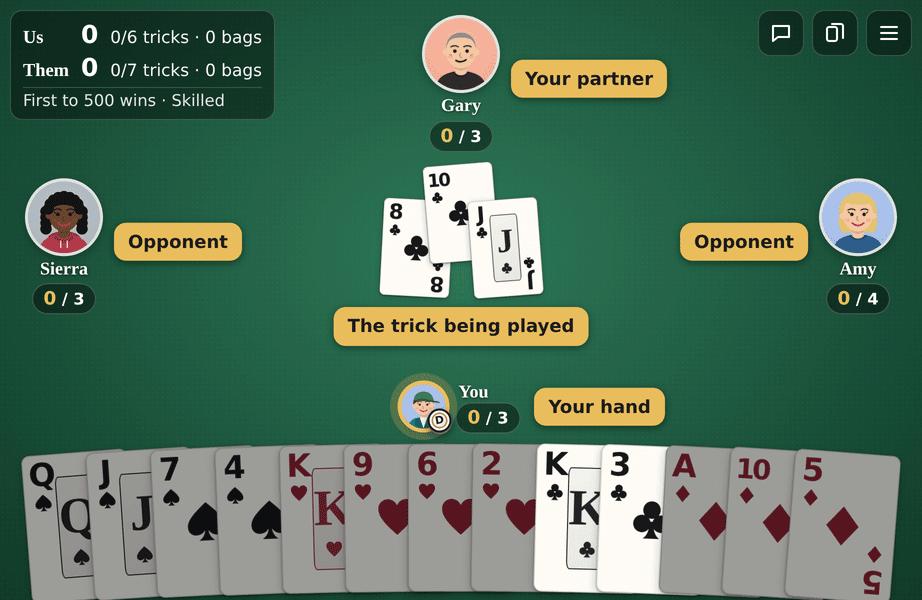
A standard 52-card deck, no jokers. The dealer hands out the whole deck clockwise, one card to each player in turn, until everyone holds thirteen. After each hand the deal passes to the left. In the game above the dealer is marked with a small D on their picture, and the cards are dealt for you.
Bidding
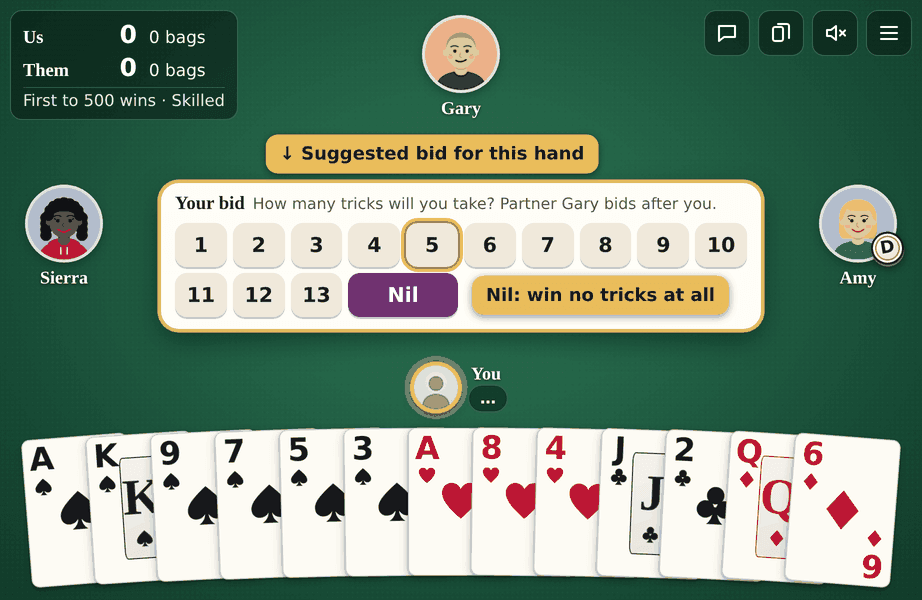
Bidding starts on the dealer's left, then moves clockwise. Each player names a number from one to thirteen: the tricks they think they can win. Add your number to your partner's and you have your team's target. If you bid three and your partner bids four, your team needs seven tricks. It does not matter who takes them.
You can also bid nil: you aim to get through the whole hand with zero tricks. Nil counts on its own, apart from your partner's bid. Keep your pile empty and your team gets 100 points; the moment a trick lands on it, the team loses 100 instead. A team that is 100 or more points behind may go for blind nil: the same zero, but called before you pick up your cards, and worth 200 points either way. On Spades.net the bid buttons show which bids are legal, and the outlined number is a suggestion based on your hand.
Playing a Trick
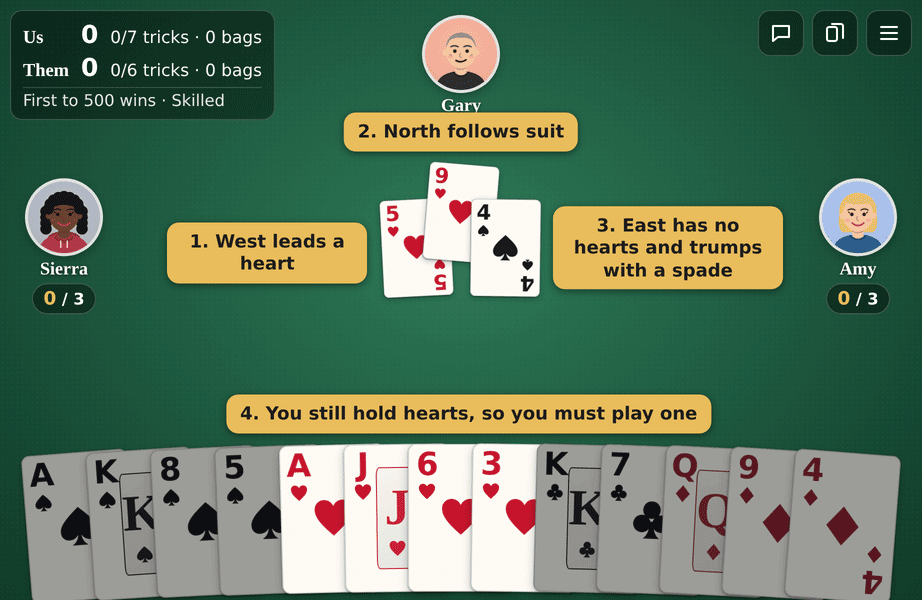
The same player also plays the first card of the hand, which can be any suit except spades. Play goes clockwise, and everyone must follow suit: play the suit of the first card of the trick if you have it. That word “first” matters. Say the trick opens with a heart and the second player, out of hearts, drops a diamond: the player after that still has to answer with a heart. Once you run out of the opening suit, you're free to play whatever you want, spades included.
With no spades in it, the trick goes to the top card in the suit it opened with. As soon as a spade shows up, the biggest spade takes it. The winner collects the four cards and leads the next trick. Aces are high, twos are low.
Breaking Spades
Nobody may start a trick with spades until they are "broken": the first time someone who can't follow suit plays a trump instead. Until then you open with something else. The one exception: if spades are all you have left, you may lead one. In the game, cards you may not play right now are shown darker, and if you tap one the game tells you why.
Scoring
When all thirteen tricks are played, each team compares its tricks with its bid.
- Made the bid: 10 points for every trick bid. A team that bid 7 and took 7 scores 70.
- Extra tricks: every trick above your bid is a bag, worth 1 point. Took 9 on a bid of 7? That is 72 points and 2 bags.
- Missed the bid: every trick you bid costs you 10 points. Bid 7, took 6: minus 70.
- Bags: bags are counted across hands. Every time a team reaches 10 bags, it loses 100 points and starts counting again from what is left over.
- Nil: plus 100 if the nil bidder took no tricks, minus 100 if they did. Tricks taken by a player whose nil failed still help their partner make the team bid.
- Blind nil: the same, for 200 points.
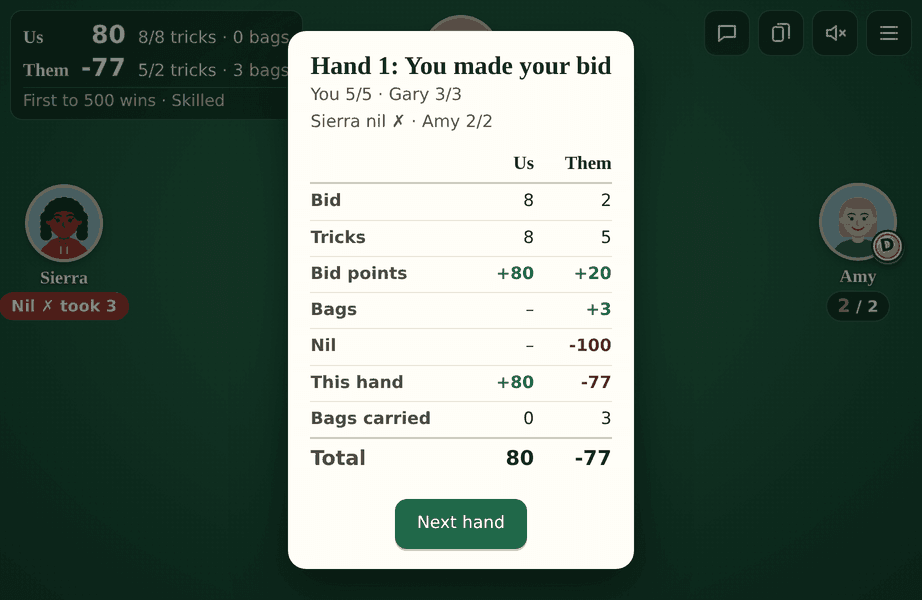
Get to 500 points before the other side and your team wins. When both teams get there in the same hand, the team with more points takes the game, and a team that falls to minus 200 loses on the spot. On Spades.net the score sheet is one tap away, and after every hand you get a breakdown that shows exactly where the points came from.
House Rules You Can Change
Spades has more house rules than almost any other card game, so the settings in the game let you switch the main ones. Play to 200, 300 or 500. Turn nil or blind nil off. Turn the bag penalty off. Let a team lose at minus 200 or not. Count the tricks of a failed nil as bags only, instead of towards the team bid. Allow spades to be led at any time. Cap partners at thirteen tricks together, or not. And if your table plays with a minimum team bid of four, switch that on too: the partner of a nil bidder then has to bid four or more. Change a rule and the next game uses it.
Ready to try it? The strategy page explains how to turn thirteen cards into a bid you can actually make.